
Category Archives: memoir

Please Let Us Be There When You Go 

My mom died at 9:47 p.m. on July 19, 2017. I had resigned from my position as an arts and music editor at an area altweekly, worked my last day, and that celebration was soon replaced by a four-day death vigil. I drove directly from my former office to my dad’s house, to sit by her side as she lay in that hospice bed. 

It had been four years of witnessing dementia slowly change her life gradient from a radiant, impassioned woman to a graying, mute semi-catatonic. By the time she died, we had the weirdly wrapped gift of a kind of expanding, anticipatory grief. Neurologists, apparently not wanting to hedge their bets, had no tidy diagnosis so it was all painfully nameless yet evident. A long preliminary trial that became nauseating through its exaggeration and unimaginable stubbornness.  

If it was a test, I failed the test. I relapsed during this time, 11 months of returning to pay blood tribute to heroin, eight years clean jacked through a rig, resigning myself to return to full-blown possession of myself.  Walking backwards into the undertow. Fake gods delivering gimcrack miracles. When I’d go see my mom, high or between highs, I’d usually leave with a stolen ten-pack of her insulin syringes in my pocket. 

But I also got clean again while she was dying. At some point, days in to kicking cold turkey, driving to see her with wobbly hands on the steering wheel, I think I might have gone down the hall into that bedroom and sat beside her, slowly wiping a cool washcloth tenderly across her face, leaning my arm against that steel guardrail on the bed, and confessed my relapse. 

I don’t know if I was burdening someone who already had enough to carry, or just carrying that pain to someone I know who would never judge it. I don’t know if it even happened or if it’s some false atonement but it seems right. It seems appropriate to she and I. 

My mom spent the last year of her life with her eyes closed, barely communicative, on her back. Her body had atrophied, her limbs reduced to useless stems. She had said one thing to my dad during the second half of that year and one thing only, totally unprompted as he was adjusting her pillow, carefully feeding her in measured spoonfuls or administering her insulin:

“Sometimes life is hard.” 

She was a woman of little complaint but when she complained she made it count. 

The hospice nurses would come by every few days. 

“She’s still in there.”

Sometimes it sounded more like a dented question than a verifiable truth. 

When I was a young boy, my mom bought me the books by Laura Ingalls Wilder. I was initially offended, thinking she was trying to turn me into, God forbid, a sissy. 

I adored those books. 

So, I’d sit next to her, holding my Kindle, and read Little House on the Prairie stories to her out loud. 

The whole time thinking, “I hope she isn’t here to hear this.” 

In the previous years and over the course of her dematerialization, I had moved from being a lifelong atheist, to a believer in some higher power, to a lapsed atheist, to furious skeptic, to a defiant enemy of God. If my mom was somehow trapped in this husk, to my confession and stories about wagon trains and impromptu homesteads on the plains, I would die at war with God, or detonate my mind trying; clamoring up from the abyss, smoldering from flames, refusing to obey.    

Waiting for someone to die is exhausting. The self-created games of distraction just collapse on themselves. I sat in the living room, all out of reasons to “go to the store,” and just sat on the floor and meditated. Sitting with my eyes closed, I could hear the ceiling fan chain clinking away above me. In that short time, I essentially forgave God for God’s transgressions against my mom. She was no saint but she was pretty damn close. 

This exchange of forgiveness that occurred is hard to articulate. It was a moment that was as awkward as it was powerful. It didn’t feel allowable. Spiritual things are expected to be revealed in slow grandeur, like a shared cloud everyone can gather around to witness, but this happened so quickly and was uncomfortably personal. But that night God seemed to almost bow and be quiet so I could let God off the hook. It felt like a lop-sided blessing. 

My dad yelled down the hall. My brother and I ran into the bedroom, me dizzy in this kind of trance of love in forgiving God, and then she died. We held her and wept, our hands were just grabbing at her arms, taking turns to kiss her face now wet from our tears, almost rocking her body to keep her soul there, disorienting her spirit so it could not find the way out to leave us behind.

She took that powerful exit exhalation, and she left the body. We each stepped away from her and then towards each other, in a shuddering, almost-electrified embrace. Then, weirdly, we simply stopped crying. We let go of one another. We were still. 

Two young guys from the funeral home had met the on-call hospice nurse at our house in a moment that was weirdly exciting because it was something new. It all seemed so methodical to them yet was surely our first time on this particular page in the book we were now all in. The two men seemed strangely overdressed, in crisp white shirts and neckties. We were a small audience, dressed in sweatpants and jeans. After they had put her in a body bag, a parcel that was colored a blunt dark-brown, they rolled her down the hall on a gurney. They accidentally bumped her head against the door frame. They gasped, mortified, and looked at my dad and apologized. Then they glanced at me. I shrugged my shoulders. I was part of the new audience portion of this moment. “She didn’t feel a thing,” said my dad, reassuringly.  

Within the hour I was in my car, driving south towards anywhere. The roads were weirdly empty for that hour and were wet, the reflection of the stoplights in the puddles of rain resembled long reddish-gray-and-green brushstrokes on a soggy canvas. I listened to Otis Redding’s “Ole Man Trouble.” Still not a car in sight at 11 p.m. Everything seemed eerie and malleable and everything felt perfect and correct. I turned back. I was a lapsed atheist again. 

Hours later my dad and I were in the living room. He was staring disinterestedly at the half-empty beer bottle in his hand. On the TV, W.C. Fields threatened to throttle his young daughter in The Bank Dick, the DVD being my attempt at levity. 

Hours after that, he and I are at the funeral home. Parked out front is a replica of the 1960s Batmobile. “FOR SALE.” 

My dad knocked on the wooden door of the building. 

A woman came to the door, squinting and seemingly surprised that someone would ever knock on the front door of a funeral parlor. 

“Are you here about the car?”

My dad looked at me, perplexed, and then back at her. 

“We’re here about a body!” 

He and I laughed. 

For Mom

(6/11/1945 – 7/19/2017)

America, You Suffer from a Jug Band Deficiency

(for Luke Faust)

My great-grandfather on my mother’s side: Wiley Craft (April 18, 1887-June 14, 1972). My brother Tim (b. 1968) and I (b. 1972) were the first men since 1910 to not wind up in the coal mines of Eastern Kentucky. Yet I have owned and can play a banjo.

By the age of eight, I had seen Bill Monroe more than I had seen a dentist. 

I can recall going to the dentist’s office when I was four. I can even remember, after the cursory exam, slowly and methodically picking a toy out of the post-check-up toy chest. It was a light blue whistle, a weird accordion-like thing.

My parents were hardly neglectful. But dentist visits were just not in their child-rearing plans. That initial visit was tantamount to my dad paying $40 or so bucks for the dentist to examine the developing gompers of my older brother Tim and myself.

“Are their teeth all there and straight?” 

I can imagine my dad asking the dentist. 

“Yes? Good. Give them their toys so we can go home. The Wildcats play Alabama in an hour.”

This frugality was hard-wired into my folks. They both grew up so poor that “teeth optional” was an unspoken assurance for any familial social occasion. 

One thing we did get as a family was a serious bluegrass treatment. 

Every year, maybe more than once a year who knows, my folks would load up the Chevy “camelback” station wagon with some quilts, lawn chairs, chips, and a cooler filled with Falls City beer and store-brand soft drinks, and we’d head to downtown Louisville, specifically to the festival grounds of Bluegrass on the Belvedere, at 4th Street and Main. 

Some of my earliest memories, my actual memories of “being a person,” are of heading to these festivals. 

My earliest memory would be around age two or three, running through our new-yet-still-vacant home in Bullitt County, just outside of Louisville, hearing my laughter and screams bouncing off the walls and floor of the empty house. My other earliest memories are tied into the blast of banjos, fiddles, and high-pitched voices while standing on the grass, happy and surrounded by other elated people.

At these festivals, the crowds of bearded, red-eyed longhairs and hippie gals in their “Hey Grandma” dresses and tinted eyeglasses were balanced out by straight-up hillbilly folks. Middle-aged men in white t-shirts and bib overalls or jeans, wearing tattered ball caps emblazoned with “Beechnut” or “Copenhagen” logos, laughing as they leaned on the back of old, prime-painted pickup trucks. Countrywomen in denim skirts or floral prints, some with long braids of hair running down their backs; others balancing impossibly sprayed beehive hairdos on their heads; the country people appeared easygoing, sweet to the point of being meek…ostensibly their day in the “big city.”  

This was 1970s Kentucky. Everybody smoked cigarettes. Years later, after identifying the aroma firsthand, I realized that some smoked weed on the sidelines. People lugged around handles of Jim Beam and rolled or carried coolers full of beer. My brother Tim and I had to watch where we stepped, our bare feet careful to not step on the few billion pull-tabs popped from those very same beer cans.

If music is the universal language, these bluegrass festivals were evidence of that wordless conversation. People would bring their own instruments, and between – or even during – sets it was common to see some Deadhead-looking dude trading mandolin licks with an ancient-looking old man who looked like he had finally crawled out of the mines of Eastern Kentucky; at least for this weekend. 

Of course, I’m remembering this through the filter of 45 years and the recollections of a child. But it seemed like a peaceful scene and over the years my dad has assured me that he never saw a hippie-hillbilly brawl erupt in the crowd.

Bands played 45-minute sets on the few stages set around the festival grounds; for local or lesser-known acts, even shorter performances were scheduled. I saw and heard some incredible music at these festivals, only a lifetime later did I comprehend the magnitude of what I had experienced as a child.

Annual and much-anticipated, headliner performances by the aforementioned Bill Monroe and band, ditto Ralph Stanley and crew, The Country Gentlemen, the earliest lineups of New Grass Revival led by Sam Bush, J.D. Crowe’s New South (featuring a young Ricky Skaggs), the Highwood String Band from Ithaca, New York, and Boone Creek, a kind of up-and-coming progressive bluegrass band with Skaggs, Jerry Douglas, and Keith Whitley. Those were just the big names. 

There were countless spontaneous jam sessions happening throughout the festival grounds. Kentucky can get a lot of shit and is an easy target for “hillbilly jokes” (including those zinged by me) but this was the Bluegrass State at its best, honoring its namesake, usually in the key of “G” and at a clipped pace, trading licks over cold beer in a downtown taken over by crazed players and music fans. 

It seems like half of authentic bluegrass music is either about celebrating your life or ending it, but on a good day it all moves in a purely electrical, ecstatic direction.

Naturally, I only heard of much of these lineups and music lineages much later. Although I can clearly recall witnessing Bill Monroe count off “Uncle Pen” and clip out the lines, “Late in the evenin’ about sundown / High on the hill and above the town” … and the entire fucking crowd would whoop and go ballistic, some nodding their heads or clapping hands, others breaking into a full hillbilly-demon-foot-stomp possession. 

Early 1950s: My dad and some polyglot of his kin most likely in Lebanon Junction, Kentucky. Please note: another banjo and various “mountain-music-making” paraphernalia are also pictured.•  

That included me. The only time I have consistently and willingly danced in this lifetime had been at these festivals; according to my parents I stomped and danced like the one-generation-from-the-coalmines city-hayseed that I was. 

At these festivals, there was no backstage area. The bands would simply park their tour buses, vans, station wagons, and trucks to the side of the performance area. If you wanted Bill Monroe’s latest album, you’d just walk up to Monroe or one of his bandmembers and ask to buy his latest album. My folks bought self-released LPs by more than one young or lesser-known artist, albums that were jettisoned when we moved down to Florida, records that I sometimes obsess over, wondering if some later bluegrass or country legend had been featured on those recordings, back during their ‘70s longhair-and-overalls days. 

“Bluegrass sucks!” 

Adolescence brings new flavors. In my early teens, the experience of hearing bluegrass had become the equivalent of walking by my dad as he watched some 1980s’ country show on the TV, either PBS, local cable access, or one of Ralph Emery’s goddamned repellent programs. Besides, we had moved 1,000 miles away from Bill Monroe and bluegrass. We had settled into the life of beach residents, albeit ones who still felt like resident aliens.

The suburbs had burned the bluegrass out of me. Pre-teen years were spent aping the music tastes of my older brother and his friends. Black Sabbath, Blue Öyster Cult, and Black Oak Arkansas had led to Venom, Mercyful Fate, UFO, and Saxon. Those bands would stomp the hoedown out of anyone with leather-wrapped cloven hooves. At the very least, that’s what they did well.

I was slowly teaching myself how to play the electric bass, and both acoustic and electric guitar. If I plunked out a 2/4 country-style riff, it was to mock that music. I was more into figuring out that elusive “metal gallop” or the bend-and-throttle style of bass-god Geezer Butler. 

Eventually, I grew tired of, even outgrew, that early style of hard rock and metal. My teenage tastes were all about flipping through a deck of cards and the metal card was flipped away. Sixties rock became “my music,” since it appealed to me and, maybe just as importantly, my brother ultimately hated most hippie music. 

1976: In Letcher County, Kentucky, cradled by mother and protected my brother; dreaming of banjos yet to be plucked.

When I was 13 years old, my mind blew out into shards. I was diagnosed with bipolar disorder, or as they still routinely called it, manic depression. While I was hardly gnawing on teachers’ desks or strangling crossing guards, it was decided that I’d be removed from school. I was conscripted into being a drop-out. I had a lot of free time, and days were spent wandering around the beaches. By the time I turned 14, no one was home at my house. My dad worked downtown as a computer programmer, my mom worked as a secretary for the school board, and at age 18, Tim was working for a swimming pool company. 

My folks would leave me a couple of bucks each day, so I’d either head down to Deane’s Books at the boardwalk in Jacksonville Beach, or just wander aimlessly, chain-smoking my ever-present Marlboro Lights and avoiding eye contact with every person, place, and thing. 

Located roughly seven blocks north of my parents’ house, the Bargain Factory took up three spaces in a nondescript strip mall on Penman Road. One part consignment shop, one-part hopeful antique shop, and three parts of towering, used junk, I could always waste a good hour rifling through the place. 

I always headed to the books first, on the hunt for some oddball sci-fi paperback or, hopefully, a beatnik writer. But usually, it was a glut of James Michener books or romance novels with that same cotton-candy-pink cover design. I once found a Pablo Neruda book published by City Lights, but after thumbing through the poems, I discovered that I didn’t understand, so in that case like, Neruda.

Sin, Sex, and Sanity, with its lurid yellow cover and a nude woman rendered in purple washes, went home with me. It was a classic of the ‘60s sexploitation era, a “cautionary tale” of various sexual deviancies in the American suburbs, that was essentially “word porn” masked as a plea for morality. It was a well-thumbed tome.

The records at Bargain Factory were in the back of the place, a couple of cardboard boxes that appeared to have been kicked under a plastic table. There were never any real surprises there; the same impossibly-happy-looking white gospel groups, Andy Gibb, holiday, and Boston albums that apparently infected every thrift shop.

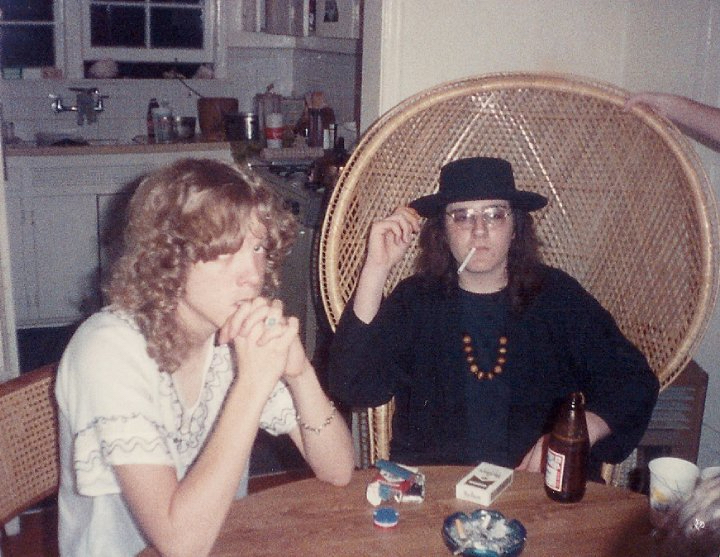
•1986: At age 14, I was a year into my “experiment with bipolar disorder.” I was also obsessed with William S. Burroughs so I dubbed myself “The Tofranil Kid,” in honor of the psych med I was then prescribed. This was also the year that I discovered the Holy Modal Rounders. My best friend Robbie looks on, understandably concerned. I am here to say that both Robbie and I turned out okay.

Flipping through the records out of habit, I stopped when I discovered two beat-up LPs. The first record had a yellow background, stained and scuffed; with a photo of various crinkled bottle caps of drinks I had never heard of: “Moxie…Gordon Scotch Ale…SKOL…Red Stripe Beer.” Scrawled at the top in black ink, “The Holy Modal Rounders,” and at the bottom: Alleged in Their Own Time. In the lower right-hand corner, the imprint, “Rounder Records 3004” was printed in cursive script.

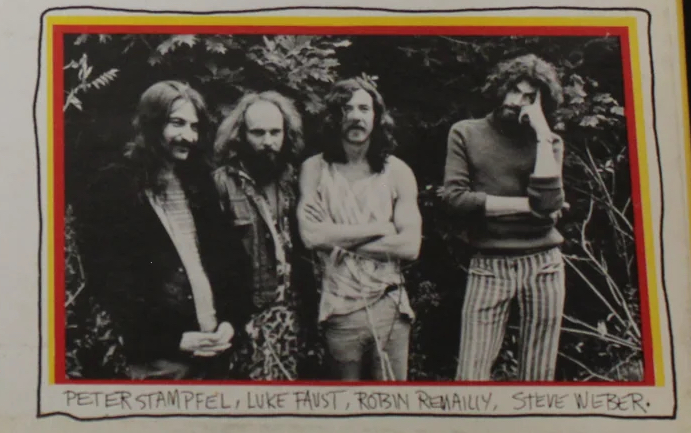
Flipping the album over revealed two black-and-white photos. The larger of the two featured the caption, “Peter Stampfel + Steve Weber,” with an image of two greasy-haired straggler guys who resembled most of my then-current heroes. They seemed to be leaning into each other, creating a kind of smiling hair tower. Ditto the lower image, with Stampfel and Weber bookending two fellow hippie derelicts apparently named Luke Faust and Robin Remaily. 

I took this and the second album and went to the counter to pay.

“How much?” I asked.

“A quarter,” said the old guy who ran the store.

“Each?”

“For both.”

I paid him, tucked them under my arm, and headed back to my house. Once home, I inspected this new find. Tucked inside was an eight-page insert, a “libretto” maybe, featuring a piece of frothy erotica called “Arabella,” by Peter Stampfel and Antonia. Also, in this booklet is a kind of stream-of-consciousness history of the band (also penned by Stampfel) and “The Survey of World Civilization as Viewed from the Head of Peter Stampfel” (presumably also by, uh, Stampfel). 

There were also four lists of “Heroes” from the 1940s-1970s. This list was the first place where I had ever seen names like “Theodore Sturgeon…Charlie Poole…Roger Zelazny…Skip James.” I had no ideas who those people were, and that list sent me on a quest to find them. It would be years before I realized how radical, and inclusive, it was to celebrate prewar country and blues pioneers with post-WWII sci-fi polymaths. Bands today might pull such a gimmick to show how cool they are; The Holy Modal Rounders were simply showing us who they were.

In my 51 years in this world, I have learned this: most any album starts out with the sound of someone blowing on a jug is usually going to be good. 

That’s the first cosmic truth I learned from Alleged in Their Own Time. That opening cut, “Low Down Dog,” kicks in with four forceful (are there any other kind?) farty huffs on a jug and then the band just falls in, a crazed shamble of fiddle, guitar, maybe a mandolin, maybe even a bass; really just a big, sloppy clomp with fiddle gliding above the whole mess. 

And then came a nasally, totally non-hayseed voice I immediately loved:

“Don’t you take me for no low-down dog…” 

A chorus barks back: “Low Down Dog!”

“Don’t you know I got my pride, I just want to walk beside you baby..” now these dudes are barking behind the singer, now joining him on the verse, “but you say, but you say, I must walk behind! Well, I ain’t holdin’ still for none of thaaaaaat stuff!” 

And more crazed fiddle.

In “Earth time,” this all happened in roughly 30 seconds, but you can’t really clock total transfixion.  

Relentless and shambling. 

My kind of institutionalized prejudice toward the music I had heard, really the first music that I had truly “heard” years earlier in downtown Louisville, quickly packed its bags and skedaddled. 

“Low Down Dog” had everything that I loved about music…that I had actually forgotten that I loved about music. 

Chaotic, unpredictable, simple, non-analytical – the Holy Modal Rounders were not out to impress. In the parlance of the Merry Pranksters, they truly “freaked freely.”

 Heavy metal had promised some kind of groin-born thuggery but that was all pricy leather wristbands and choreographed menace. The Holy Modal Rounders, this kind of countercultural-hayseed music, was as mysterious as it was emotional. 

If I had heard the first few bars of this album without ever seeing the band, I’m certain that I would have still had the same specific response: 

These are unhinged people playing old-timey, mountain music that many folks would rather have contained or imprisoned in those mountains. 

BUT THEN…

“Who will feed you peaches when I’m gone?” 

And that fucking chorus: (“WHEN I’m GONE?!”) “Your new lover may be cute, but does he bring home the fruit, my baby?” Now together again as one voice, “But you say, but you say, peaches make me fat! (FAT!) Well, I ain’t holding still for none of thaaaat stuff!”

I didn’t even realize I was an atheist and now I had found God and God still had 90 more seconds until His song ended. 

I could go on and on.

So, I will.

Any sane person wonders about their death, and if they were totally honest, they also wonder, just as importantly, “What song will I force my mourners to listen to at my funeral?”

My song is the second song, side one of Alleged in Their Own Time.

That song is called: “Don’t Seem Right.”

From the outset, the opening melody kind of peeks around the corner, looks behind itself, and then slowly steps into the song. 

“Shortnin’ Bread” on Seroquel in the key of ‘D major”— play along: “F#/A/D/ F#/A/D/ F#/A/D/B/A/B/A/F#/E/D” then to “G”!!! All in 10 seconds, and then…

“Well, see them kids / On the skids” … each word sung atop that melody so lovingly transcribed above… “Livin’ just the way / their folks just did / well it (G major, right now!) don’t seem right / don’t seem right to me (D major) / Well, it (A major!) don’t seem like  / that’s how it’s gotta be.” Stumble back to D and repeat, repeat, repeat!   

It was akin to F. Murray Abraham as Salieri, pushed to the breaking point and weeping over hearing Mozart’s music. But I didn’t want to KILL the Holy Modal Rounders – I was ready to follow these hairier-than-a-horde-of-hippies motherfuckers into the frontlines of the Jug Band Wars! 

“Don’t Seem Right” might be one of the more somnambulant protest tunes going, but, at age 14, it reaffirmed what I already knew and chiseled it down to its purest and refined state: everything is a mess.

People try to dismiss this truth, some are paid the big bucks to do it, but at the end of the day everything is a fucking shit show engulfed in black fire and nothing seems right. Then it is up to us to figure out some kind of religious, philosophical, spiritual aesthetic to pick through rubble that keeps on cascading around us. 

People invariably come to spirituality through pain. Then they inflict more pain on others by talking about their newfound spirituality. This shit will never end.

•The “Alleged”-era of the Holy Modal Rounders with Luke Faust—who is innocently unaware of the deranged future-teenager he would transform, let alone the mawkish memoir-song review he would unwittingly spawn. •

“Don’t Seem Right” rails against indoctrinated education (“go to school / learn a rule / come out the other end an educated fool / well, it don’t seem right…”) the certain crush of life (“look at daddy / daddy’s wife / old folks cheated out of half their lives /well, it don’t seem right…”) and the checkered flag at the end, the only trophy we will all win, our true entitlement (“well, folks are born / lived it all / then they’re sorry they ever lived at all / well, it don’t seem right…”) closing out with the rallying cry (“well, if you feel the way I do / why don’t you / start singing it, too…”) then the band chiming in how it “don’t seem right.” Hope prevails. 

Now look – memory and taste can pollute any experience, let alone the emotional zap that happened during that moment. But since I first heard “Don’t Seem Right,” I have played this song in every possible setting, legal or otherwise, when I have been happy, melancholy, during the ongoing “conversion process of playing the uninitiated ‘Don’t Seem Right’” and the result is always the same: a nudge into a greater, and thankfully ongoing, awakening. 

I was a frustrated child and now I am a frustrated man and this song deals with universal frustration. 

I’ll blast this flare even higher into the sky and claim that “Don’t Seem Right” is a campfire tune jabbing at bigger, occultic truths. 

When Christ acknowledged that his disciples were “not of the world any more than I am of the world” (John 17:14), he was succinctly delivering a “The World ‘Don’t Seem Right’” sermon. Centuries later, St. Therese of Lisieux cribbed Christ’s message as, “The world’s thy ship and not thy home.” 

She was right on the money. 

Why? Because this world simply “Don’t Seem Right.” 

Every great mystical tradition teaches this truth over eons of teaching, study, and disciplined practice and the Holy Modal Rounders wrapped it up in under five minutes. 

If Sri Ramakrishna were around today, he would surely slather himself with clarified butter and joyously weep among a flock of peacocks, collapsing into deep samadhi while chanting, “Sahee Mat Dekho! Sahee Mat Dekho!” 

“Don’t Seem Right” protests everything. It’s a ballad for not the fallen but rather the contorted. “Don’t Seem Right” is the sound of a single string of suet, plucking over every past and eventual graveyard.

Since discovering “Don’t Seem Right,” I have taught myself how to play electric and upright bass, electric and acoustic guitar, banjo, and mandolin and you can bet a bean-shaped organ that I have plunked out “Don’t Seem Right” on each and every one of them. 

While I am all knuckles on the keyboard, I have plinked out that main riff on many a piano. I have turned my Dad into a “Don’t Seem Right” devotee and during our acoustic guitar honky tonk duets, songs by Waylon, Merle, and old Hank, are always met with a rousing sing-along of “Don’t Seem Right.” I began sending this song backward through space and time, like a kudzu vine zipping up the family tree. During the pandemic, eagerly vaccinated and masked up, I would visit my father. I would sit a good eight feet away from him, and we would break out the old 1981 Epiphone acoustic guitar and inevitably sing “Don’t Seem Right.” 

I could slobber on about the entire range of Alleged in Their Own Time. The cautionary tale of “Voodoo Queen Marie,” who can terrify or hypnotize beasts with a simple walk by. The marrow-deep downhome moan of “Chitlin’ Cookin’ Time in Cheatham County” hits me right in my Kentucky solar plexus. Sung in that nasally and truly “high lonesome sound,” death-row stagger. Ditto “She’s More to Be Pitied.” 

“She’s More to Be Pitied” dips deep into that pre-electricity-mountain-wail and Carter Family pool; my Grandma Edna knew three chords on the guitar, and when she played it, she held it in some esoteric, sideways position. 

When she was a little girl, the family acoustic guitar hung on the wall and she was forbidden to touch it. So, as a child she secretly taught herself how to play by lifting her arms up and quietly strumming and fretting the strings. 

Can you stop for a second and process that? Astounding, really. I keep trying to learn Spanish, Sanskrit, Hebrew, etc. and I give up when the “language-teaching app doesn’t load fast enough.” Fuck all.

My grandma would play tunes like ‘Will the Roses Bloom in Heaven” and “Don’t Let Them Tear That Little Brown Building Down” – songs that sound like they were written 10,000 years ago. Let me tell you, she could’ve played the hell out of “She’s More to Be Pitied.” Maybe she did. Public domain.

Shame can be as complex as more desirable feelings like love and gratitude. Within those levels, are illusory qualities. Writing a love letter and once signed, you can realize you never loved them, even though it’s a great letter. 

There is such a thing as false shame, too, even guilt. 

Putting the noose around your neck for a crime you mistakenly believed you had committed.

A felony mirage. 

In that jarring and bumpy ride from childhood into early adolescence, it feels that, for whatever the world doesn’t blame you for, you’ll take the time to blame yourself. 

By the time I had discovered Alleged in Their Own Time, I had started the chameleon-like and perpetually self-doubting process of “being” a teenager. 

First I was “into” metal, then currently a hippie, soon the hair would be cut and turned black, for now I have “gone punk.”

The Holy Modal Rounders and Alleged in Their Own Time kind of cauterized and burned down this false belief that I didn’t like old time, bluegrass music. When in fact, I loved that music. Less than a decade earlier, I used to dance and twirl to it, as non-rock-star bluegrass players unleashed this music onstage at the festival stages of my childhood. 

Alleged in Their Own Time not only obliterated the shame of being, essentially, a suburban hillbilly. It actually assured me that it was perfectly okay, a natural state that was equal to any other; at times even greater than most.

A few years ago, after posting some mawkish and manic celebration of “Don’t Seem Right” I posted something to the effect of Steve Weber being a “genius” for writing the song. 

Thanks to the weird “no-real-degree-of-separation” that’s increasingly inherent in social media, my Facebook “friend” (the mind reels) and founding Holy Modal Rounder, Peter Stampfel, chimed in that it was actually Luke Faust, not Weber that wrote and performed “Don’t Seem Right.” 

Yet another paradigm shift, delivered by one of the key culprit shifters of the main paradigm.

Oh, this life.

Postscript: The “second album” that I mentioned that day? Have Moicy! by the Unholy Modal Rounders, Michael Hurley, Jeffrey Frederick & The Clamtones, a truly seismic release from 1976. That album deserves its own separate rant, but my blood runs full of  Alleged in Their Own Time.

But what a great day to be young and have a quarter in your pocket, huh?

Grimoire Mentis Emphaticae: Sigil Grimoire of Every Psychiatric Medication/Daimon/Augoeides of Which I Have Been Prescribed (1985-present day) with Lesser Rulers

A Memoiric-Occultic Account by Daniel A. Brown

CHLORPROMAZINE — the First Spirit is the Principal- Antipsychotic King ruling in the Southeast, called Chlorpromazine. He maketh thee to go mute. He appeareth round with hints of citrus hues. He answers to the lesser names of Thorazine and Largactil. He frees one from junior high school, ending formal education (grades 7-9) and grants the power to smoke Marlboro Lights in a greasy arcade that reeks of lurking salted and abandoned memories, located in a rickety pier. 
Hebrew Gematria: 936

CHLORPROMAZINE

TRIFLUOPERAZINE — the Second Spirit is the mercurial Duke of Phenothiazines, who lurked near Deane’s Books and the Crab Pot Restaurant (circa 1985), known as Trifluoperazine. He responds to the name of Stelazine, taking the form of a light-blue orb. His powers include luring one into home-schooling via the public school system. He negates most obsessions with The White Album.
Hebrew Gematria: 1165

TRIFLUOPERAZINE

IMIPRAMINE — the Third Spirit is the mighty Prince Imipramine; responding in kind to the names of Tofranil and Tofranil-PM. His powers include enchantment via Quicksilver Messenger Service; procurement of Thai stick from a man with a duffel bag circa 1985. Failing burglary attempts at a VFW Hall, one may attempt moonlight Onanism if the working of Imipramine remains unchecked. 
Hebrew Gematria: 273

IMIPRAMINE 

TRANYLCYPROMINE — the Fourth Spirit is a Jester of monoamine oxidase inhibitors (“The Irish Jheri Curl”) known by the aeons as Tranylcypromine. Pink, churlish appearance; also answers to the dry-mouthed exhortation of Parnate. He dooms one to the music of Ornette Coleman and grants tenuous power to tolerate others describing “Harmolodics” to baffled 1990s-fanzine creators. Like Psalms to an elemental, Bananas are anathema to Tranylcypromine. 
Hebrew Gematria: 1318

TRANYLCYPROMINE

PHENELZINE — the Fifth Spirit is the spurious Heart-Girt spirit known as Phenelzine; or “Nardil the MAO | IAO Cupid.” Planetary orange in color, Phenelzine grants one the ability to admit eternal love to an equally troubled girl while standing in a tent. Caveat: the tent must be in a yard, far removed from any forest. 
Hebrew Gematria: 692

PHENELZINE

BENZODIAZEPINE — the Sixth Spirit is a disembodied witch of somnambulance (“The Crossroads Sorceress of Pfizer”) called Benzodiazepine; she grants wisdoms as she maketh one forgets through gradients including anxiolytic, psycho-leptic, “genius-memetics,” and sedation. She answers by many names: Ativan, Halcion, Klonopin, Valium, and Xanax, and appears in myriad forms; ovoid, round, fragmentary. Powers of double-vision and forgetfulness (“Prospector’s Dilemma”) are common. Lesser concerns include un-invoked word-of-mouth PR work for Kitaro and Jean-Michel Jarre to pharmacists. 
Hebrew Gematria: 1230

BENZODIAZEPINE

ARIPIPRAZOLE— the Seventh Spirit denotes the “softening of the names due to marketing research” and is called forth as Abilify and Aristada. Appearing as a hermaphrodite, Aripiprazole brings chocolate oranges to depression-support groups as the peer advocate breaks into spontaneous operatic arias during the smoke break. Aripiprazole is attracted to Golden Corral buffets and sweating in bed in the middle of winter. 
Hebrew Gematria: 875

ARIPIPRAZOLE

AMPHETAMINE and DEXTROAMPHETAMINE — the Eighth Spirit is the “chattering of the aethyrs.” A mystical chimera, answering to the names of Adderall and Mydayis, the conjoined forces of Amphetamine and Dextroamphetamine bring the gift of unearned illumination and volatile hypergraphia. If carelessly invoked, both Adderall and Mydayis can enchant one to fall in love with a 1986 VHS cassette of a pornographic film. 
Amphetamine Hebrew Gematria: 289
Dextroamphetamine Hebrew Gematria: 828

AMPHETAMINE and DEXTROAMPHETAMINE

ATOMOXETINE — the Ninth Spirit answers to the three-fold call: “Strattera! Strattera! Strattera!” A lord of psychostimulants, Atomoxetine banishes cats, sleep, appetites, and common sense while clarifying delusions into 5,000-word unreadable dreck. He grants the power of self-abnegation in appetites and salacious longwindedness. A hesitant sort, Atomoxetine takes one-to-four weeks to fully materialize but once embodied in the circle, grants men the power to breastfeed and women the ability to ignore the cries of the mystified suckling-foundling. Verbosity, an indifference to sleep, and a thirst for fancy mineral waters are but a gleam of the bounty brought forth by this slow-arriving-yet-jocular spirit. Grimoric lore maintains that Atomoxetine sprayed from the body of Simon Magus as his body fell to earth: now the site of the Simony Pharmacy located near present-day Nablus (formerly Flavia Neapolis).
Hebrew Gematria: 690

ATOMOXETINE

BUSPIRONE — the Tenth Spirit is the sire of sobbing cigarettes, answering only to the name of Buspar. Buspirone is approached when Duncan Hines is in retrograde and He ruleth over 1214 spirits. He appears as a discarded floss-stick in the parking lot of an automotive parts store, granting one the power to ignore a torrent of psychosomatic cop-outs.
Hebrew Gematria: 536

BUSPIRONE

FLUOXETINE — the Eleventh Spirit is the ruler of agitated relocation and can barely be contained in the circle when called as Prozac and Sarafem. A verified trickster, Fluoxetine gives the power of “emphatically good ideas,” along with relocating to Rincon, Puerto Rico, and stacking a functioning television on a broken, wood-paneled console television. 
Hebrew Gematria: 735

FLUOXETINE

OLANZAPINE — the Twelfth Spirit is a first-line spirit named Zyprexa, appearing either fully invisible or as a monocle-wearing owl who smokes a bubble pipe, and rules over a congregation of lesser atypical anti-pneumatic spirits.  The “last of the harsh-sounding spirits,” Olanzapine keeps one safely in home, secure from the Federal Bureau of Invisibility; allows one to climb the courtyard of a closed bank without attracting mosquitos; be gifted with the ability to drive a stick-shift (once), and eat cold taco meat over the kitchen sink with no need of lamp or flame-light. In the grand theurgical tradition, Zyprexa is a fickle daemon most foul. While one may gain inner wisdom, one should also expect weight gain, no improvement of psychomotor retardation, hand tremors, foot glimmers, and lessening discernment in the ability to identify what is chthonic beings with merely cocaine psychosis [documented in The Frogs They Chanted, “Without Wait, Without Wait” from a Palm Valley Pond; Niels Vallè; 1836]
 Hebrew Gematria: 726

OLANZAPINE

CITALOPRAM — the Thirteenth Spirit is a secondary spirit invoked as Celexa.Lording over 20 sub-spirits, he grants the power to shoplift an industrial-size container of lampreys from an Alabama salvage store, control the direction of thrips, and make a melancholy rat somewhat less melancholy. 
Hebrew Gematria: 354

CITALOPRAM

DULOXETINE — is the Fourteenth Spirit and lord of the infant class of spirits and appears as Cymbalta. A swindler spirit, he will trade priapism for polyuria, and his assistance is hindered by making one suspiciously sweat in bank lines, pharmacies, and department store changing rooms. Duloxetine disappears as he arrives: as a mandala of cockroaches.
Hebrew Gematria: 733

DULOXETINE

VALPROATE — the Fifteenth Spirit rules over a legion of one thousand subservient off-label spirits and is called forth as Depakote. The only known spirit with a myrrh allergy, she brings fallow fields to abundant harvest, appears in visions as holding ice in each hand while rising from the sea, and allows the mage the power to cry only four times within twenty-three years; no more, no less. 
Hebrew Gematria: 1017

VALPROATE

ISOCARBOXAZID — is the Sixteenth Spirit and invoked as MarplanMarplon, and Enerzer. An ancient chthonic gate-keeper spirit, Isocarboxazid takes stubborn residence under a picnic table at Lake Jericho in Smithfield, Kentucky and appears as fireflies. Successful invocation is confirmed by the sound of the music of Don Williams within the third ear and a temperature drop in cracked, empty fish aquariums.
Hebrew Gematria: 1099

ISOCARBOXAZID

VENLAFAXINE — the Seventeenth Spirit is called as Effexor and appears as a rusty bicycle in the woods (Note: in previous grimoires, Venlafaxine takes the form of a penny-farthing compromised of skulls or a Scottish Rites pogo-stick). In cases of resistant somnambulance, envelopes from creditors change color from white, to pink, to yellow, and so forth. Beneficent powers include the Power of the Blind-Eye, and the banishing of excessive Grateful Dead podcasts. 
Hebrew Gematria: 1127

VENLAFAXINE

LAMOTRIGINE — the Eighteenth Spirit first appears as a vision of a 1970s Kiddierama Theatre coin-operated animation vending machine and answers to the call of Lamictal. The rare spirit that rules over thirty dominions while affecting both the prefrontal lobe, pineal gland, perineum, and other alliterative and hindering, flesh-tethered parts of the “hermetic booty.” Lamictal grants the power to improve one’s forgetfulness in increasing the magician’s obliviousness to ever being aware of forgetting anything. A tandem power to prevent convulsions (“Headlock of the Hidden Gods”) is offset with the power to form a rock band called The Agram Tooth and flood the music community with a glut of cassette-only releases wrapped in baby doll hair and blue candle wax.
Hebrew Gematria: 351

LAMOTRIGINE

MIRTAZAPINE — the Nineteenth Spirit is Remeron. A late-arriving servant, a fortnight may pass before Mirtazapine arrives to aid one’s troubles. Appearing in the mouth and vibrating in the gullet chakra, this feisty spirit has the power to raise the prescription pad from a pain management physician, “as a Tulpa brought forth from the Tibet-yan’s barbaric fluting” (– Z. Woollacott, 1913; “Incident in Tib-yet.”) If unattended, one will awake in disorientation, in a dimly-lit room teeming with half-consumed cans of cola, walls covered in carpet.   
Hebrew Gematria: 835

MIRTAZAPINE

QUETIAPINE — the Twentieth Spirit is called forth as Seroquel and is a watchtower spirit. Arriving as a vision of a field of wheat; a blue sky; sun’s fire on one’s face; and a melodious cross-breeze, this “queller of intrigue” languidly provides all answers to unwanted questions and grants the power to complete all crossword puzzles—in ink pen, no less and grants one the lifelong boon to never own a pet too large so that one cannot kill said beast with one’s own bare hands. 
Hebrew Gematria: 499

QUETIAPINE

CARBAMAZEPINE — the Twenty-First spirit is indifferent to names and arrives if invoked as Tegretol, Equetro, Epitol, Tegretol XR, Carbamazepine Chewtabs, Carbamazepine CR, Carbatrol, Teril, or Carnexiv. Successful summoning is denoted by eye tremors and a bout of hypoglycemia during a screening of the film Jacob’s Ladder. A princess of fauna, Carbamazepine is known to take the form of an invasive species known as dioscorea bulbifer; colloquially known as the “air potato”—not to be confused with the Indianmeal moth (plodia interpunctella) or, “air monkey.” Granted powers include avoiding imagined assassination attempts, protection from paraffin in all forms, and the superhuman ability to eat vast meals.
Hebrew Gematria: 737

CARBAMAZEPINE

ESCITALOPRAM — the Twenty-Second spirit is a chattering interlocutor and called forth from the abyss by the names Lexapro and Cipralex. Her arrival is marked by a temperature increase in the temple, a soft melodious penny-whistle tune “heard” in the molars, and via excreta of sour water through the glands. She transmits her answers through repeated coincidences of Blind Faith’s “Can’t Find My Way Home” playing on FM radio, during the arrival of the “red tide” algal bloom in the ocean. She grants the powers of remote viewing of small electronic devices in pawn shops and the shared vision of the Sabbatic Solar Cycle: “What I will buy when I win that lottery.”
Hebrew Gematria: 449

ESCITALOPRAM

LITHIUM — the Twenty-Third spirit is the Duke of Principalities of the dry-tongue and tight-fitting denim and is conjured thorough the names of Priadel, Camcolit and Liskonium, Eskalith, Eskalith-CR, and Lithobid. Lithium appears as a small child composed of chrome who wears a garland of forgotten ideas around its neck. The power of general thought-placation is granted within weeks, conjoined with a [hopefully] false memory of masturbating in the bathroom of a 1991 mental hospital; polyuria, and coming home after a secondary suicide attempt in the form of breaking down sobbing while listening to the outro of Brian Eno’s “The True Wheel,” and the subsequent crying a total of four times for the next 20 years.
Hebrew Gematria: 376

LITHIUM

GABAPENTIN — the Twenty-Fourth spirit is called Neurontin and is a mercurial figure in various grimoires. Neuralgia is lessened and one is also granted the power to drug one’s cat with this spirit to give the mesmerized feline a highly reluctant bath. The Pseudomonarchia Delirium of Gailard Sartain of München [1716] describes Gabapentin appearing as a cascading tower of boiled peanuts, expired prescriptions, and menthol cigarettes lighting and extinguishing themselves in alternating sequence. Powers granted include a reduction in focal seizures and an increase in flirting with a nurse in the ICU, whilst restrained to a hospital gurney and realizing that happiness is a divine birthright.
Hebrew Gematria: 265

GABAPENTIN

PAROXETINE — the Twenty-Fifth spirit is invoked by the names of Paxil and Seroxat and assists in maladies including depression, bipolar depression, obsessive-compulsive disorder, panic disorder, H.R. Giger wheeze, and falling in love with a woman who is inconveniently married with a recently-paroled frontline foot-soldier of the Aryan Brotherhood, but she really wants you to “check out her new band’s demo.” Paroxetine takes the form of electrical zaps in the central nervous system, followed by spontaneous sobbing while watching Close Encounters of the Third Kind; this spirit rules a dominion of four counterfeit watchtower angels who take form as Maine Coon cats wearing 1980s new-wave eyewear and garish spats. 
Hebrew Gematria: 650

PAROXETINE

RISPERIDONE — the Twenty-Sixth spirit answers to Risperdal and boasts rulership over some four million failed ceramicists of the elemental variety. The Renaissance goetic sorcerer and insufferable manick-depressive Loggia Sinforia (1512-1567) wrote a controversial treatise on the volatile evocation of Risperdal, arguing the merits of allowing the spirit to enter the host-body fully. Sinforia argued that such an arrangement allowed one to expertly bow a trombone and command pigs to protect the magician through the use of a handcrafted fipple flute, or flageolet. To create the Risperdal Fipple Flute, a discarded toilet paper roll is punctured with the antler of a Tibetan pygmy yak, then buried in wet soil during a “fool’s moon,” while being seen by no one during the digging, burial, and retrieval. This magical implement is not to be confused with secular toilet paper fipple: the “dur-dur.”
 
Hebrew Gematria: 432

RISPERIDONE

SERTRALINE — the Twenty-Seventh spirit is beckoned through the name of Zoloftand rules over a legion of plush-toy demiurges and is the only pure IAO Inhibitor in this spirit-catalog. A spirit attracted to the bucolique de banlieue (translated: suburban bucolic), Sertraline appears as a neglected fig tree, boasting rotten fig pods recognizable by their sickly-sweet aroma. Sertraline and her demiurgic multitudes grant the power of hiding half-smoked joints in dental-floss boxes, concealing faith-based pornographic magazines within one’s clothing, and the ability to alienate friends and family with emphatic and argumentative opinions; views wholly uninformed yet fully opinionated. Such are the words.
Hebrew Gematria: 430

SERTRALINE

ASENAPINE — the Twenty-Eighth spirit reluctantly arrives by the name of Saphris. In the Vajrayana tradition, Saphris appears as a jewel-encrusted ox; in the Western esoteric schools, her presence is verified by the sound of a pickup truck door being repeatedly slammed, the poignant call of a train at 4 a.m., and a memory of nearly burning one’s metal-shop teacher with an acetylene torch while being blinded from donning grease-smeared plastic goggles. Saphris grants the power to quickly carry a small dog down the antiseptic hallways of a convalescent center, to turn old folding money into lurid origami, and to draw the face of William Butler Yeats in the condensation of a cold, damp window. 
 
Hebrew Gematria: 251

ASENAPINE

CARIPRAZINE — the Twenty-Ninth is brought forth through the intoning of the “barbarous names”: Vraylar and Reagila. This spirit rules over all 341 sub-elementals and grants the power to refrain from espousing utterances such as, “I take agency over my light-body…I am taking a posture of authenticity.” Cariprazine assists one in the etheric realm, and grants the powers of merciless expulsion of Astral Voyeurs. Contact with the arrival of Cariprazine is verified by flickering lamps, feverish symptoms, sweatiness and nausea (“The Roiling Paraclete”), and the overwhelming urge to propose marriage to a group of seals located in a remote Scottish loch via the practice of Seal Kasina. 
Hebrew Gematria: 788

CARIPRAZINE

TRAZODONE — the Thirtieth spirit arrives when addressed as Desyrel, Desyrel Dividose, Molipaxin, Oleptro, Trazodone D. Judicious care must be taken when dealing with Trazodone: when visible to the human eye, this spirit (who lords over the Typhonian sleep elementals) may faintly appearing as a shimmering and luminous mallet. Trazodone’s main boon is the power to grant one a deep, unending rest; the abyss of the manifest and unmanifest, the dreamless sleep. [See also The Prajna of the Scurrilous Hindoo, Father Kipyard Rudling; 1903]. While not a certified trickster spirit, Trazodone can lure the conjurer into sleeping for hours, days, weeks, or even while reading this far into this paragraph.
Hebrew Gematria: 830

TRAZODONE

BUPROPION – the Thirty-First spirit is named Wellbutrin and Zyban. One of the youngest spirits cataloged in this grimoire, Bupropion borrows its name from the famous priapic angel of the Chaldean papyri. Legend has it that the final king of the Neo-Babylonian Empire (Nabonidus: b.620–615 BCE; d. 539 BCE) warned of the Aeon of Zyban; thankfully his fears are unfounded. Once successfully invoked, Bupropion grants the power of tobacco cessation, wards off needy men walking around with parrots on their shoulders and yellow boa constrictors draped around their necks, and “a surfeit of gnosis in regards to the late-1960s music of Albert King.” Most encouragingly, the potential side effects of Bupropion are limited to anxiety, constipation, dry mouth, excessive sweating, insomnia, liver toxicity, nausea, psychosis, “slow-eye,” tremor, and accidental death. 


Hebrew Gematria: 551

BUPROPION

Holy Lotus Breakdown

Tom Catton, "Dharma Opening of the Heart," and Bea Austin. August 2009; meditation retreat in Estes Park, Colorado.

Tom Catton, “Dharma Opening of the Heart,” and Bea Austin. August 2009; meditation retreat in Estes Park, Colorado.

In 1986, I was a confused 14 year old boy, fucked up like a soup sandwich. Two events merged into one in my then trembling field of being. Through a mediocre Jim Morrison biography I had discovered the Beat Consciousness – Kerouac, Ginsberg, Burroughs, etc… They were part and parcel of my simultaneous awakening and corruption. They in turn introduced me to Buddhism (and the romanticizing of drugs). I spent many teen nights trying to decipher the Tibetan Book of the Dead (the only book I ever stole – catch that Karmic irony!) and the Diamond Sutra with burning pot smoke curling up into my eye. The Beats took Buddha off of the takeout menu and centered him into my psyche. Kerouac made Christ sound like the original beat, assuring me that “Walking on water wasn’t built in a day.” Buddha spoke of suffering, but as a young teen I simply took this as this: “all life is shit.” Fair enough. At one point I even had the grandiose plan of one day going to the Naropa School in Boulder, CO., to study at the Jack Kerouac School of Disembodied Poetics, whatever the hell that was. I went as far as to order the Course Catalog, excitedly showing my Dad as he nodded and tried to look interested as the UK Wildcats played on the TV.

Continue reading

A Hateful Child on a Night Watch Spree

1987; aged 15.

1987; aged 15. At one point, I was prescribed so much Lithium that I referred to myself as the “Human Salt-Lick.”

(This is an edited memoir excerpt that I had originally posted as a note some time ago on FB and had also been previously posted on a website devoted to spirituality and recovery. I wrote this four and half years ago in an attempt to summon my precise mindset during my 14th and 15th years, after being diagnosed with having Bipolar Disorder. At that time in my life, I was prone to these nightly walks that were as senseless as they were somehow mandatory. Looking back, I think I was simply in a manic state and maybe that constant motion helped me keep one step ahead of the pain I could never seem to elude. If the writing or sentiment seems like that of an adolescent, then I have succeeded, for that is the very voice I was trying to both resurrect and reconcile in this piece.)

Continue reading

Kissing the Goat

Ouija Boards, Acid and Retinol Cream

baphomet11 Baphomet Pentagram

(What follows is my first memoir piece for STAREHOUSE, chronicling some of the highs and lows of my spiritual and mental journey of the past 25+ years, however real or imagined. I had previously published parts of this as a note on Facebook. I have changed the names of all parties involved; the rest is all true – or at least what I believed to have happened to me.)

A spiritual awakening implies that previously in my life, I was not awake. I had fallen asleep, gradually at first through detached, selfish behavior and then more directly through a series of increasingly expensive, self-induced chemically tuned lullabies. I had removed myself from all of the work and all of the play, having little time or patience for other people and even less for a positive, spiritual life. God became a vacancy sign, and then gradually read “Closed for Business”.

Continue reading